


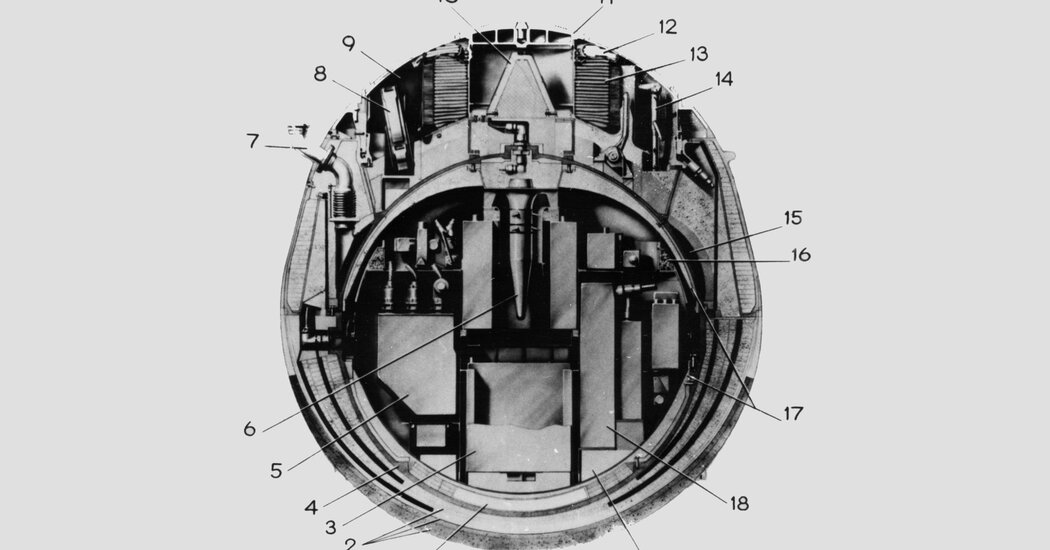

After touring the space for 53 years, a rebel Soviet spacecraft called Kosmos-482 returned to the earth, entering the planet’s atmosphere at 9:24 AM, Moscow time on Saturday, according to Russmos, the state corporation.
Designed to land on the surface of Venus, Kosmos-482 may have remained intact in its immersion. It was splashed in the West Indian Ocean or Yakarta, Indonesia, Roscosmos said.
Kosmos-482 was launched on March 31, 1972, but remained stranded in the earth’s orbit after one of its rocket reinforcements closed prematurely. The return of the spacecraft to Earth was a reminder of the competition of the Cold War that caused visions of science fiction terrestrial powers that were projected in the solar system.
“Remember a time when the Soviet Union was adventurous in space, when we were all more adventurous in space,” said Jonathan McDowell, astrophysicist in the center of Astrophysics of Harvard & Smithsonian who was launched. “It’s a bit bittersweet moment in that regard.”
While the United States had won the races to the Moon, the Soviet Union, through its Venera program, kept her view in Venus, the twisted sister of the Earth.
From 1961 to 1984, the Soviets launched 29 spacecraft towards the wrapped world next door. Many of those missions failed, but more than a picture no. The Venera spacecraft surveyed Venus of orbit, collected atmospheric observations while descending gently through his toxic clouds, picked up and studied soil samples and sent the first and unique images that we have from the planet’s surface.
“Kosmos-482 is a reminder that, 50 years ago, the Soviet Union arrived on the planet Venus. Here is a physical artifact of that project, of that moment,” said Asif Siddiqi, a historian of the University of Fordham who specializes in Soviet-Era-Era-Era-Era-Era-Era-Era-Era-Era. “There is something strangely strange and convincing for this, about the past it still continues to orbit the earth.”
Half a century later, as the nations plan a return to the moon and throw their probes towards Mars, Jupiter and asteroids of Varousy, a lonely Japanese space probe is the only vehicle that orbits Venus. Other proposed missions have faced uncertain delays and future.
Duration The space race, putting boots on the moon was the biggest prize, but the other worlds in our solar system also called. As the United States focused more and more on Mars, the Soviet Union changed its eyes to the second rock from the sun.
“Both parties had interest in Mars at that time, but Venus was an easier goal,” said Cathleen Lewis, curator of international space programs and space costumes at the National Museum of Air & Space of Smithsonian institutions.
Almost the same size as the earth, Venus is or is known as its twin, although it is as little similar to the Earth as the rocky planets. It is wrapped in a thick atmosphere or carbon dioxide and hidden under miles of sulfuric acid clouds. An occasion in a fugitive greenhouse effect, the surface of Venusian is an extinction of 870 degrees Fahrenheit, and crushed by atmospheric pressures approximately 90 times greater than those of the earth.
“How is something that can survive a multimanth trip through the solar system, reach a planet through a thick atmosphere, reach the ground and not melt or be crushed, and take photos?” Dr. Siddiqi asked. “He is a son of an incredible problem to think of solving in the 1960s.”
Without flinching for the challenges raised by such a punishing world, the Soviet threw their hardware to Venus, again and again. And there was no template on how to do it at that time.
“I was literally inventing what you want to send to Venus,” said Dr. Siddiqi. “Today, if a country like Japan would like to send something to Venus, he has 50 years of textbooks and engineering manuals. In the 60s, you had nothing.”
The Soviet Venera program achieved a series of superlatives: the first probes to enter the atmosphere of another planet, the first spacecraft in landing safely on another planet, the first to record the sounds of an alien landscape.
The fault of Kosmos-482 occurred in the middle of that timeline. And Saturday’s re -entry was not the first encounter of the Earth with the Venus Lander planned.
Around the local time of April 3, 1972, only a few days after the problematic launch, the city of Ashburton, New Zealand, was visited by several 30 -pound titanium spheres, each the size of a beach ball and marked with cirilic letters.
One ended in a turnip field, which alarmed local citizenship. The New Zealand Herald reported in 2002 that one of the spheres “was possible in a police cell in Ashburton because no one knew what to do with him.”
Althegh Space Law images that the ownership of a star spatial object remains with the country that launched it, the Soviets do not claim the property of the spheres at that time. The “space balls” were possible returned to the farmers who found them.
And while Kosmos-482 was lost, he is a brother, who had launched one leg a few days before, any landing in Venus was called Venera 8. That spacecraft survived and transmitted surface data for 50 minutes. Two years later, when Veneta 9 and 10 arrived, for the Soviets, building in redundancy meant launching two of everything, they slowly descended through the clouds, they landed in the surf surf of the planet.
The Venera program ended in the mid -1980s with the ambitious Vega probes. These missions were launched in 1984, they threw land on the Venusian surface in 1985 and flew through Halley’s Comet in 1986.
“The legacy of the Soviet exploration of Venus of the 70s and 80s was a point of pride for the USSR,” said Dr. Lewis.
Kosmos-482 re-entry, although unique for historical reasons, is not so unusual. Today, nations and companies are launching even more hardware in orbit, without leaving a shortage of objects that fall from heaven.
“Reettries are very frequent now,” said Greg Henning, an engineer and spatial debris expert at the Aerospace Corporation, a non -profit organization with federal support that tracks objects into orbit. “We are watching dose of them a day. Most of the time they go unnoticed.”
That is especially true at the present time, when the sun is quite active, because greater solar activity swells the atmosphere of the earth and increases the drag of objects into orbit.
Some of those re -entry set spectacular shows. They can be the result of controlled entries back to the earth, such as those of the Spacex load and crew capsules. Others are accidental, such as failed test flights of Spacex’s spacecraft prototypes. And others are deliberately uncontrolled and enhanceable quite dangerous, as has been the case of rocket reinforcements of March 5B of China, objects large enough to cause significant projects if they again focus a populated area.
But rarely, an object like Kosmos-482 will return to Earth as a record of the first steps of humanity in the space that ceates the earth.
“There is a space race file, which still surrounds the earth. There are so many things that were launched in the 1950s, 1960, 1970,” said Dr. Siddiqi. “Sometimes they remind us that this is this museum there because it falls on our heads.”
Jonathan Wolfe Contributed reports.