


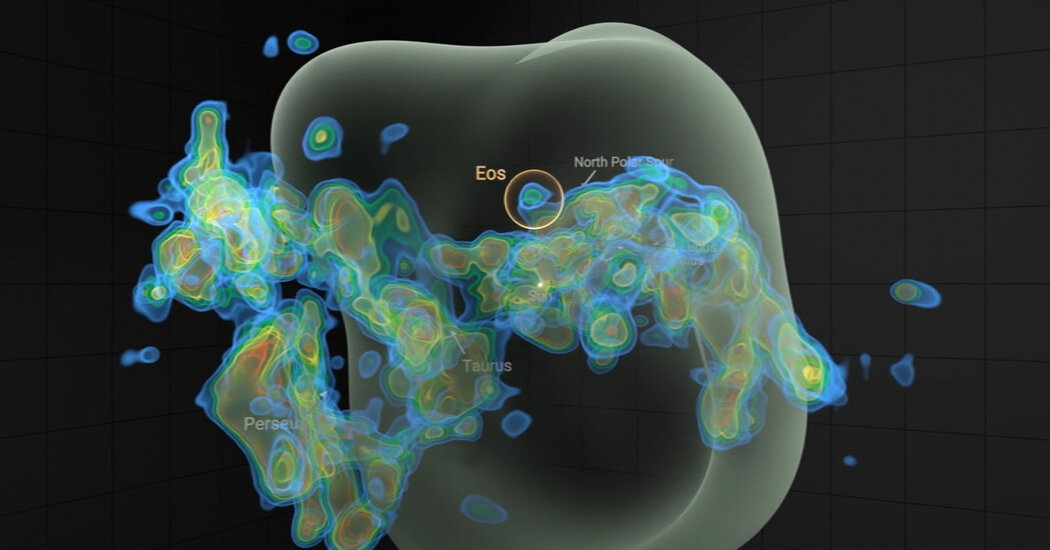

The stars and planets are born within the rotating clouds of cosmic gas and are full of hydrogen and other molecular ingredients. On Monday, astronomers revealed the discovery of the cloud of knowledge closer to Earth, a potential colossal of spot in the form of a crescent or a potential for the formation of stars.
Called Eos, after the Greek goddess of dawn, he found the cloud stalking about 300 light years of our solar system and is so wide axis 40 of the earth mons aligned in the sky. According to Blakesley Burkart, an astrophysicist at Rutgers University, is the first molecular cloud that is detected using the fluorescent nature of hydrogen.
“If I saw this cloud in the sky, it is huge,” said Dr. Burkhart, who announced the discovery with colleagues in Nature Astronomy magazine. And “he is literally shining in the dark,” he added.
Identifying and studying clouds such as EOS, particularly based on its hydrogen content, could remodel the understanding of astronomers of how much material in our galaxy is available to produce planets and stars. It will also help them measure the rates of creation and destruction of fuel that can promote such formations.
“We are, for the first time, seeing this previously hidden hydrogen deposit that can form stars,” said Thavisha Dharmawardena, an astronomer of the University of New York who is the author of the study. After EOS, he said, astronomers “hope to find many more” such hydrogen clouds.
Molecular hydrogen, which consists of two united hydrogen atoms, is the most abundant material in the universe. Star nurseries are full of full or they are. But it is difficult to detect the molecule from the ground because it shines in large culture wavelengths that are easily absorbed by the atmosphere of the earth.
Easier to detect is carbon monoxide, a molecule formed by a carbon atom and an oxygen atom. Carbon monoxide radiates light in longer wavelengths that can be detected by radio observatories on the earth’s surface, a more conventional technique to identify stars -forming clouds.
Eos, as immense as it is, evaded the detection for so long because it contains so little carbon monoxide.
Dr. Burkhart noticed the cloud while studying data that had about 20 years of the Great Cultivation Image Spectrograph, or FIMS, an instrument to a Korean space satellite. He saw a structure in molecular hydrogen data in a region of space where he believed that molecular clouds were not present, and then associated with Dr. Dharmawardena to investigate more thoroughly.
“At this point, I know almost all molecular clouds by name,” said Dr. Dharmawardena. “This structure did not know at all. I couldn’t place it.”
Dr. Dharmawardena verified the discovery with three -dimensional maps of interstellar dust between stars in our galaxy. These maps were built with data from the recently removed Gaia space telescope. Eos “was very clearly described and visible,” he said. “It’s this beautiful structure.”
John Black, an astronomer from the Technological University of Chalmers in Sweden who did not participate in the work, praised the technique used to reveal EOS.
“It is really wonderful to be able to directly see molecular hydrogen, to track the contours of this cloud,” said Dr. Black. Compared to carbon monoxide, hydrogen shows “a more true image of the” or EOS shape, he added.
Using the molecular hydrogen content, astronomers estimated that the mass of EOS is approximately 3,400 times that of our sun. That is much higher than the estimation calculated from the amount of carbon monoxide present in the cloud, only 20 times the mass of our sun.
Similar measurements or carbon monoxide could be underestimating the mass of other molecular clouds, Dr. Ir. Burkhart said. That has important implications for the formation of stars, he added, because the largest clouds form more massive stars.
An EOS monitoring study, which has not yet reviewed by leg pairs, discovered that the cloud had not formed stars in the past. But the question remains if it will begin to produce stars in the future.
Dr. Burkhart is working with an astronomer team to conceptualize a NASA spacecraft called EOS, which also inspired the name of the newly discovered cloud. The space telescope would propose could map the molecular hydrogen content of the clouds in the galaxy, including its homonym.
Perhaps such a mission would find more hidden clouds or review knowledge about the ability to know the star mists to merge their material in stars and planets.
“We really don’t know how stars and planets are formed,” said Dr. Burkhart. “If we can directly look at molecular hydrogen, we can how the birthplace of the stars are being formed, and also how they are being destroyed.”