


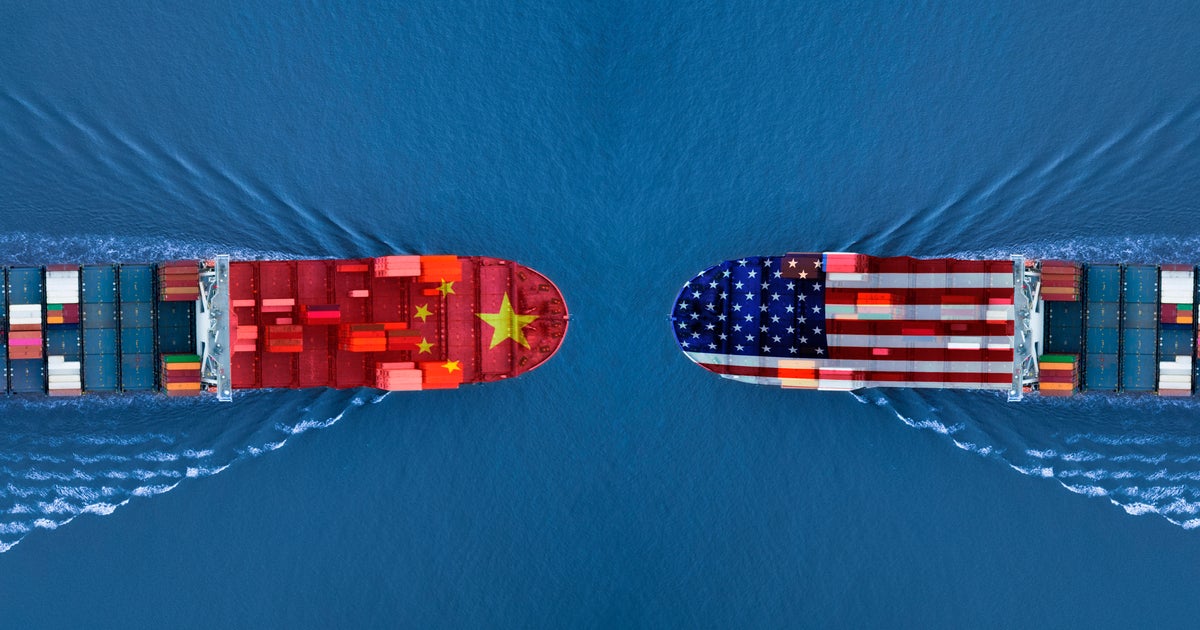

TO Tariff truce Between the United States and China announced on Monday, it will sacrifice a certain relief, but will also prolong the child of economic uncertainty that hinders companies to plan the future.
As of May 14, the United States will reduce its maximum rate rate in Chinese imports from 145% to 30%, including 10% base line collection plus a specific 20% fentanyl gravamen. China will reduce its 125% tariff on US goods to 10%.
But it is likely that a long -term commercial agreement will be challenging, while the reduced tariff rate of 30% could still lead to price increases for consumers, experts told CBS Moneywatch.
“It remains to be seen if the United States and China can agree on a commercial agreement that prevents tariffs from recovering in 90 days,” said Givkal analysts, an investment investigation firm, in a report. “Until now, only the United Kingdom has reached an agreement with the United States, and that doesn’t tell us much.”
Is 30% of the rate permanent?
No. In the absence of a formal commercial agreement, there is no guarantee that President Trump won again to raise tariffs on China once the truce expires after 90 days and that Beijing also won reprisals. The United States Secretary of the United States, Scott Besent, described the new reference rate as a “floor” in an interview with Bloomberg Vigillance.
“This is just a 90 -day break that allows the two countries to work for an agreement,” Moneywatch, supply chain expert, Sina Galara, assistant professor at Robinson College of Business at Georgia State University, told CBS.
Is it still a 30% tariff on high Chinese imports?
According to the agreement, the United States will reduce tariffs on Chinese products from to 145% to 30%. Even so, that repeats a steep walk at the level of US taxes on China before Trump taught a position.
“If you look at where we were were pre-liberation day ‘or When Trump to Office, This’ Agreement’ is just a Baseline Tariff to 30% Across The Board,” Said Alex Jacquez, Chief of Policy and Advocacy at Groundwork Collaborative, A Left-leef-left-left-leef-left-leef-leef-leef-leef-leef-leef-leef-leef-leef-leef-leef-leef-leef-leef-leef-leef-leef-leeftive president Trump used to announcing an announcing one Floor of tariffs April 2. “While it is a setback of the prohibitive rates of 145%, it still does not leave more concession or renegotiatives fish-à-porcelain peppers than us.”
Tariff rates are not the only potential conflict points as countries continue to negotiate.
“The two countries have many complaints in many dimensions, so they are not just rates of rates,” said Golara. “It is where they remain in other commercial barriers, the commercial imbalance and the United States accusing China of currency manipulation, so there is much to discuss. It makes sense that they want to take longer.”
What does the truce between the United States and China mean for economic growth?
There is good news here: if the reduced tariffs of both countries remain in their place, consumer confidence is likely to improve and increase spending. That should help contain the inflation of the United States and help support the labor market, according to the associated economist of Oxford Economics, Grace Swimmer.
The announcement also reduces the probabilities of the United States economy. Entering a recession This year, according to experts. Oxford’s head of Economics, the American economist Ryan Sweet reduced his prognosis for a 35% recession from more than 50%.
Will China’s shipments begin to flow again?
Large and small businesses equally in the United States have warned that the highest tariffs will increase consumers, while some companies have canceled the orders of Chinese factories because the high levies.
“It is very clear that Trump was watching the cannon of a great drop in China imports in the most busy shipping season, as companies build inventory for Christmas and the holiday season,” said Jacquez de CBS Moneywatch of Groundwork Collaborative. “There were more ads from the companies on the burning of their inventory and having to approve customer costs, or have to stop importing from China.”
Load shipments from China are expected to increase the duration of the 90 -day rate, as companies increase their inventories to protect against the foundation of commercial conversations and encumbrances. As a result, shipping rates will increase and squeeze closer businesses, whose margins are already thin.
“At this time, you will see a great hurry when trying to get imports from China in this 90 -day period. That will force shipping logistics as it did in Covid, when everything opened again,” Jacquez said.
Will consumer prices still increase?
Companies still face added costs with 30% established tariffs, and some of those expenses are likely to pass consumers. But price increases could be less substantial on how companies handle tariffs, according to the Golara of the Georgia State University.
“If we have a combination of some companies that handle tariffs, we gain the increase in broad base inflation to a painful level. We could see embolized effects on different products and sectors,” he said.
Other experts agree that Puse is good news for companies and consumers.
“The tariffs were so punishing that this incentive was creating to not import anything from China,” Moneywatch told CBS, Veronique de Rugy, a senior researcher at the Mercatus center at George Mason University. “The announcement is also good news because it means that the supply will not be as restricted as it was.”
It does not mean that the US is completely out of the forest, he thought. “It is still a significant increase in taxes for US consumers. We are still in a position worse than us,” said rough.
How are companies reacting?
Companies are still dealing with significantly economic uncertainty, which hinders the planning of the future.
“If it is a small business and does not know what their contributions will cost next week or in 90 days, it will be extremely disseminated doing business in this uncertain environment,” Jacquez said.
Kim Vaccarella, founder and CEO of Bogg, a company of bags and beach accessories based in the United States that manufactures its products in China, has been fighting to change at least its manufacture to Vietnam and Sri Lanka Tara
“We were looking for alternatives and established viable sources in both countries, and we were working to make there,” Moneywatch told CBS.
Then came the announcement of the White House on Monday. With the US at the beginning of this year, he had raised his tariffs in the country over Vietnam and Sri Lanka to O46% and 44%, respectively, China can again be the best vaccarella option.
“Now we are back to the starting point, because at 30% they are less demanding to manufacture in China,” he said. “If the tariffs remain at 30% or go down, it seems that we spend a lot of money trying to disasters disasters production elsewhere, because that would have more acceptable bone under this current nightmare.”
A leading index of the optimism of small businesses has fallen every month this year, there, remains above their levels before the November presidential elections.
Vaccarella had warned Customs that the price of his company’s bags could jump as soon as Julio. “But 30% can work,” he said. “There may have to be a small increase, but it will not be what a leg to 145%would have.”