



The first group of White South Africans To whom the USS granted the status of refugee, is scheduled to fly outside Johannesburg on Sunday, authorities said.
The flight from the Johannesburg or Tambo airport would leave around 2 PM ET and the route to replenish before flying to Washington, DC, the group includes 49 South Africans Afrikaner, composed of mainly families, as well as a few messages.
“The request for permission (for land) said it is the Afrikaners who move to the United States as refugees,” Collen Msibi, spokesman for the Ministry of Transportation of South Africa, told AFP.
The plane, an American charter plane, will arrive at Washington Dulles international airport at 6 am Monday morning, and then fly to Texas.
Msibi said his department had not received any other request for additional resettlement flights.
American officials have planned a press event on Monday at Dulles airport to welcome the group, according to Government documents obtained by CBS News last week. Sources familiar with the effort with CBS news that the moment of the plan could change.
In February, President Trump issued a Executive order Ordering officials to use the United States refugee program to reassure Afrikaners, which are an ethnic group in South Africa composed of descendants of European settlers.
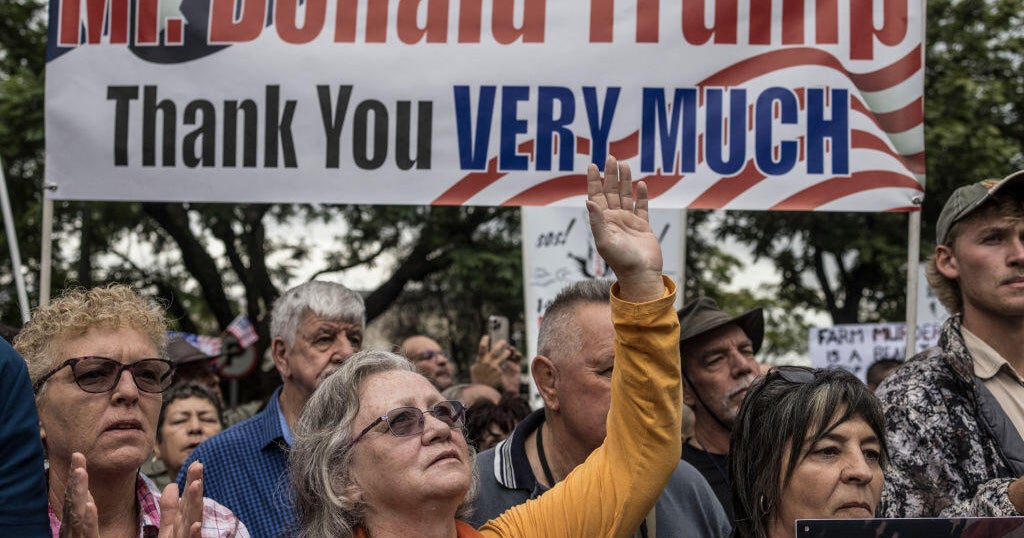
Trump, at that time, said that the White South Africans faced “discrimination of the breed sponsored by the Government.” He cited a law that the conservatives of the United States, such as Elon Musk, born in South Africa, have said that allowed land seizures racially motivated by White South Africans. The land expropriation law is intended to correct the inequalities rooted under the old apartheid system.
The South Africa government has strongly denied land confiscations or discrimination motivated by Racia.
The agreed agreed initiative to welcome Afrikaners is in marked contrast with the Trump administration movement to prohibit most of the other refugees from entering the United States.
Afrikaners’ processing granted refugee status has also been unusually rapid. Before Mr. Trump’s second term, the State Department said the refugee process, on average, between 18 and 24 months to complete due to background verifications, medical examinations and other interviews. Afrikaners ready to travel to the United States have gone through that process in a matter of months or even a week.
Meanwhile, relations between South Africa and the United States have kissed this year in a variety of national and foreign policy issues, which culminated in Washington’s expulsion from the Pretoria ambassador to March.
Trump said in March that any South African farmer looking for “fleeing” would have a “fast path” to US citizenship, despite stopping all other refugee arrivals to the United States immediately after having a position in January.
The South Africa Ministry of Foreign Affairs said Friday that Afrikaners’ resettlement “under the appearance of being” refugees “is completely motivated by political and is designed to question the constitutional democracy of South Africa.”
However, “it would not block citizens who seek to leave the country to do it,” he added.
In a statement, the State Department said that the American embassy in Pretoria, South Africa, has been interviewing those who have requested resettlement to the United States under the directive of Mr. Trump to welcome Afrikaners and continue to receive consultations.
“While we cannot comment on individual cases, the State Department is prioritizing consideration for the resettlement of American refugees in Afrikaners in South Africa who are victims of unfair racial discrimination,” the department added.
White South Africans, which represent 7.3% of the population, usually enjoy a higher standard of living than the black majority of the country.
Mainly, governments led by Afrikaner imposed the brutal apartheid system based on the breed that was of black South Africans, which constituted 75% of the population, political and economic rights. The country allowed the same vote in 1994, which led to the election of Nelson Mandela as the first black prime minister.
Sarah Carter and Camilo Montoya-Galvez contributed to this report.