


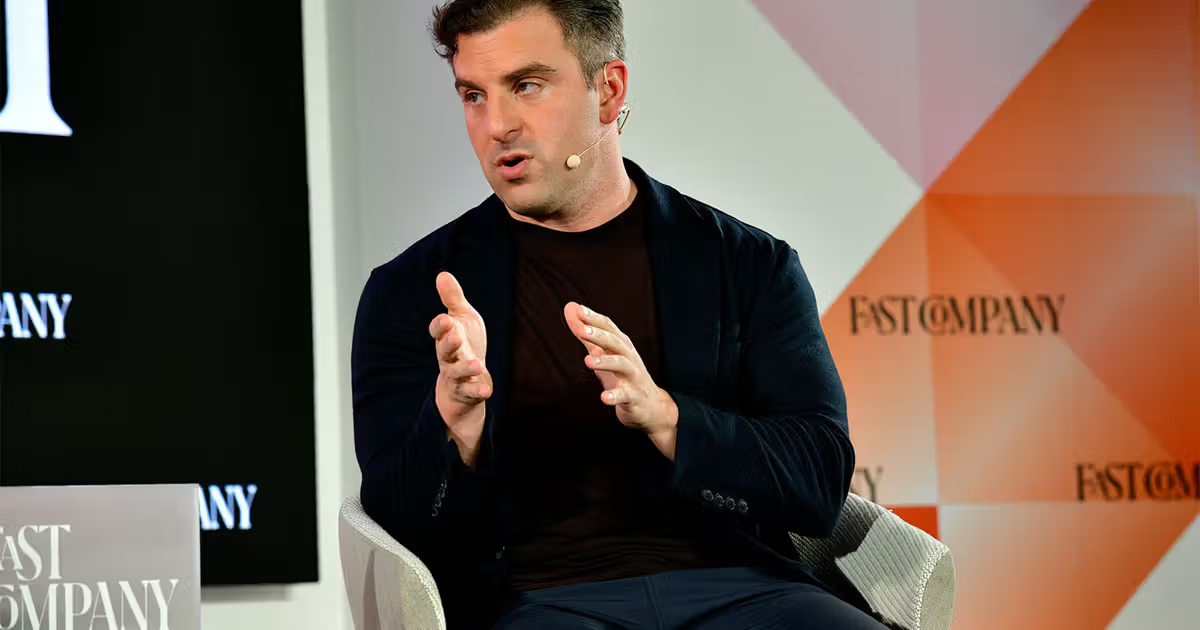

Fledgling founders entering a three-month residency at Y Combinator often start their term with a bang: Brian Chesky, the cofounder and CEO of Airbnb, fires off an inspirational speech. His company, of course, started with three nobodies going through the program. This year, Chesky topped himself. Y Combinator cofounder and nonresident guru Paul Graham (who years ago traipsed off to England and turned the enterprise over to a series of CEOs) reports that the talk so dazzled the budding tech moguls, alumni, and top investors that some were calling it the best talk they ever heard. It moved Graham to double down on a view he has had for many years—that founders are a superior form of humans. He published an essay on his thoughts entitled “Founder Mode.” People haven’t stopped talking about it since.
Silicon Valley, CA — In a world that glamorizes entrepreneurship as the ultimate career leap, getting into “founder mode” is increasingly seen as a rite of passage. But behind the buzzwords, pitch decks, and fast-tracked funding rounds lies a truth that most don’t say out loud: starting a company is as much about luck as it is about hustle.
Today, an emerging generation of would-be entrepreneurs is asking the question: What does it really take to get into founder mode — and stay there?
The Mirage of the Overnight Success
Everyone knows the story: a brilliant dropout builds an app in their dorm, scores a meeting with a top-tier VC, and the rest is unicorn history. But for every viral tech success, there are thousands of ideas that never made it past beta, and founders who burned out before they hit product-market fit.
“People think it’s just about grit and grind,” says Erica Lin, founder of a failed AI health startup turned venture partner. “But timing, networks, even the city you live in — these play a much bigger role than most want to admit. Honestly? You have to get lucky.”
That sentiment is echoed by David Nunez, co-founder of a logistics automation platform that just closed a $20 million Series A. “We got our first customer because a friend of a friend worked at a warehouse that was desperate for a quick fix. If that intro hadn’t happened, we’d probably still be cold-emailing and burning cash.”
The Obsession With “Founder Mode”
Social media has contributed to a new obsession: the aesthetic of entrepreneurship. On platforms like LinkedIn and X (formerly Twitter), founders share threads about 4 a.m. routines, investor meetings, and “zero to one” journeys. The phrase “founder mode” has come to represent more than starting a company — it’s a mindset, a lifestyle, and for some, a status symbol.
“It’s like a performance now,” says Dr. Kelsey Amanpour, a behavioral economist at UC Berkeley. “People post photos of whiteboards and late-night strategy sessions to signal seriousness. But very few show the sleepless nights over payroll, or the guilt of laying off half your team.”
She adds: “It’s like we’re romanticizing chaos.”
What Luck Really Looks Like
To be clear, founders aren’t dismissing the value of hard work. What they are increasingly acknowledging, especially in 2025’s startup landscape, is the critical role of serendipity.
Ash Patel, who runs a founder coaching platform, says: “There are two types of luck in entrepreneurship — passive and engineered. Passive luck is being born into the right network or having family capital. Engineered luck is when you make 100 asks, and one finally lands. Both matter. Both are real.”
He points to the recent rise in solo founders who landed big wins after niche audiences on TikTok or Reddit unexpectedly went viral. “Was that product brilliance? Sure. But it was also timing. That video hits two weeks later, and maybe it flops.”
The Post-Hype Reality
In 2025, venture funding has become more selective. Many VCs are pulling back on speculative investments and demanding clear revenue paths. That’s putting extra pressure on founders to not just start — but to survive.
“Early-stage founders used to be told, ‘Just build a cool product, and the money will follow,’” says Jessica Raines, a principal at growth fund Apex Capital. “Now we’re telling them: Show us traction, show us cash flow. The bar is higher.”
Still, Raines insists luck plays a part even at the fundraising stage. “You can have the best pitch in the world, but if you’re the fifth AI startup we see that week, good luck standing out.”
Reframing the Founder Narrative
There’s a growing call among startup veterans to reframe what success looks like. Rather than idolizing only the unicorns, many are encouraging transparency and nuance.
“Not every founder builds the next Stripe or OpenAI,” says Lin. “Some create a great $5 million business that changes lives. Some pivot and become incredible operators. That’s success too.”
So, Want to Get Into Founder Mode?
If you’re thinking about entering founder mode in 2025, here’s the uncomfortable truth: you’ll need drive, clarity, skills — and luck. You can plan, study, and sacrifice, but at some point, the world has to say yes.
“Getting into founder mode isn’t just about ambition,” says Nunez. “It’s about being in the right place, with the right people, at the right time — and being ready when lightning strikes.”
Because when it comes to building a startup, you should be so lucky.